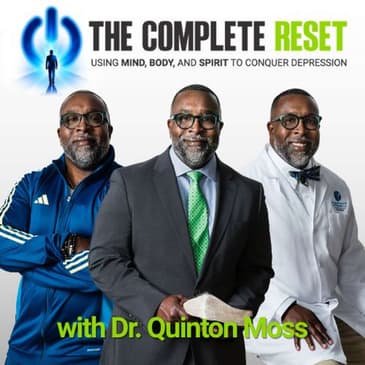
Welcome back to The Complete Reset with Dr. Quinton Moss. In our last episode, we explored how addiction is a brain-based condition and why today’s substances have made recovery more complex. This time, we’re taking things a step further by diving into the world of dual diagnosis, the intersection where substance use and mental health conditions like depression, anxiety, trauma, and bipolar disorder collide. These are not isolated struggles; they often feed into each other, making recovery much more challenging when they’re treated separately.
In this episode, we unpack what dual diagnosis truly means, why integrated care is essential, and how treating the whole person not just one symptom can open the door to real, lasting recovery. Dr. Moss shares clinical insights, explains the neurobiology behind co-occurring disorders, and highlights why coordination among providers is key. We’ll also talk about the powerful role childhood trauma plays, the importance of holistic and personalized treatment plans, and why tackling both addiction and mental health together gives people their best shot at a complete reset.
Let’s get into it.
00:00 Substance use and mental health connection
06:30 Addressing substance use and mental health
10:24 Challenges in holistic client care
11:41 Addressing mental health and addiction
14:47 How therapy and meds stabilize brain
21:12 Starting patient care conversations
25:01 Customizing treatment with therapy and meds
26:37 Factors influencing recovery and care
31:37 Connecting mental health and recovery
Whole-Person Healing: Insights on Dual Diagnosis from "The Complete Reset"
On the latest episode of "The Complete Reset," Dr. Quinton Moss dove into the complexities of dual diagnosis when mental health conditions like depression, anxiety, trauma, or bipolar disorder exist alongside substance use disorders. Their conversation cut through common misconceptions, highlighted the importance of treating the whole person, and offered hope for anyone struggling to break free from the cycle of addiction and mental illness.
What Is Dual Diagnosis?
Many people assume addiction is simply a battle with willpower or a moral shortcoming, but as Dr. Quinton Moss reiterated, addiction is a brain-based condition. Dual diagnosis, explained Dr. Quinton Moss at 01:21, refers to the coexistence of substance use disorders and other mental health issues. This might look like someone battling alcoholism while also managing depression, or someone living with bipolar disorder who misuses opioids. The interplay between these conditions makes recovery more complicated, each can fuel the other in a vicious cycle.
How Common Is Dual Diagnosis?
Statistics suggest 35–65% of people with substance use disorder also have another mental health condition, but in clinical practice, Dr. Quinton Moss sees numbers closer to 80–90% (02:30). Many patients struggle for years, not realizing they’re actually facing more than one challenge. Sometimes it’s depression or anxiety leading to self-medication with substances; other times, the chaos and trauma of addiction create new mental health symptoms. Frequently, it isn’t a question of which came first, but rather how both must be addressed together (05:31).
Why Treating Conditions Separately Fails
Despite what’s still common practice, treating addiction and mental health as separate entities can actively undermine recovery. Dr. Quinton Moss painted a vivid picture: imagine someone detoxing from substances, but whose untreated anxiety or depression sends distress signals through the brain, triggering cravings and undermining sobriety (08:02). If mental health symptoms aren’t treated, the brain keeps looking for the “solution” it knows using again.
It’s a recipe for relapse. And when providers don’t coordinate, patients bounce from one specialist to another, each addressing only a fragment of the bigger picture (10:24). Medications can even work at cross-purposes if doctors don’t collaborate, adding to frustration and risk.
The Neurobiology Behind the Struggle
The brain’s reward system, emotional centers, and decision-making regions are all interwoven in dual diagnosis. Dr. Quinton Moss explained how areas like the nucleus accumbens, which drives addiction interact with regions responsible for mood and anxiety (13:56). Effective treatment, then, must target all parts simultaneously, using both therapy and carefully-coordinated medication regimens tailored to each individual’s needs (17:30).
Trauma as a Key Factor
Trauma, especially early in life, was highlighted as a major factor that reshapes the brain’s capacity to handle stress and experience pleasure (18:16). Adverse childhood experiences can make it harder for people to feel joy or regulate their emotions, increasing the lure of substances as a coping mechanism. For long-term healing, trauma must be addressed alongside mental health and addiction, not as an afterthought.
Integrated, Holistic Care: The Modern Standard
As Dr. Quinton Moss put it, true recovery is about integrating care from the very first encounter: therapy, medication management, case management, and support services all working in tandem (21:12). At his practice, one person fully trained in mental health and addiction conducts the first assessment and builds out a treatment map that covers both substance use goals and mental health needs (22:31).
In addition, holistic approaches are essential. Addressing physical health (like hypertension or diabetes), promoting exercise for its brain-boosting effects, and offering support for spiritual well-being are all crucial supports (30:14). Everyone’s recovery journey is unique what works for one may not work for another (27:27) so true healing demands teamwork and personalization.
Key Takeaway
The message from this episode is clear: recovery isn’t about fixing one problem at a time. It's about understanding and treating the deep connections between the brain, mind, and lived experience. If you, or someone you love, is struggling with both addiction and mental health, know that there is hope and whole-person care is the path forward.
Podcast's Website - https://thecompleteresetpodcast.com/
Dr. Quinton Moss - https://thecompleteresetpodcast.com/about
Dr. Quinton Moss' Clinic - https://mpwhealth.com/
Dr. Quinton Moss LinkedIn - https://www.linkedin.com/in/quinton-moss-md-86a336149/
Podcast Partner - https://tophealth.care/
We're seeing that most of the people, closer to 80 to 90 percent, have some substance use disorder and also some mental health condition. Dual diagnosis is actually having two co-ocurring conditions. And when we think about this, we particularly think about someone who has a substance use disorder. But alongside that, there is still another mental health condition: this depression or this anxiety disorder or bipolar disorder or schizophrenia or ADHD. Those things are being suffered at the same time, which raises the level of complexity. If I am a psychiatrist in a mental health clinic and I say I don't deal with the substance use disorder stuff that's somebody else's thing, then that person continues to suffer even with the mental health. The challenge is that we have many providers who do a very good job with substance use disorder, who do a very good job with mental health, but they keep things still subtle.
SPEAKER_00In our last episode, we talked about addiction as a brain-based condition, not a moral failure, and why modern substances have really made recovery more complex than ever. And today we're taking it one step further. Because for many people, addiction is not the only trouble. Depression, anxiety, trauma, bipolar disorder. These conditions often exist alongside substances, feeding into each other in ways that really make recovery harder when they're treated separately. So today we're talking about dual diagnosis, what it is, why it matters, and how real recovery happens when we treat the whole person, not just one symptom. So let's get into it. It's great to see you, Dr. Moss, as always. Absolutely. I'm excited to get into this. I know the last episode we talked about Matt, and prior to that we talked about substance use. So talking a little bit about dual diagnosis today is really gonna help paint the picture even a step further. So with that being said, let's let's kind of jump into the term dual diagnosis. I think it's something that gets used pretty frequently, but many people don't truly understand it. So, from your perspective, what does dual diagnosis actually really mean?
SPEAKER_01So, again, thanks for for being here. So, dual diagnosis is actually having you know two co-occurring conditions. And when we think about this, we particularly think about someone who has a substance use disorder, whether that's with alcohol or methamphetamines or some type of opioid or cocaine. But alongside that, there is still another mental health condition. So someone may have this substance use disorder and this depression or this anxiety disorder or bipolar disorder or schizophrenia or ADHD, and those things are you know being suffered at the same time, which raises the level of complexity, of course, in how people may experience their symptoms and their struggles, but also brings another level of complexity when we think about treatment.
SPEAKER_00Absolutely. And clinically, how common is it for substance use disorder to coexist with conditions like depression, anxiety, trauma, or even bipolar disorder? And why do these conditions often show up together?
SPEAKER_01Yeah. So that's another good question. So statistics show that maybe 35 to 65% of the people who suffer from a substance use disorder will also have some other mental health condition, right? That's what the research shows. But you know, as we are practicing out in the field, you know, treating people and people that are coming in for care, we're seeing the numbers are actually much higher than that. So we're seeing that most of the people, you know, closer to 80 to 90 percent, have some substance use disorder and also some mental health condition. As we talk about that, there's always the question of which was there first, what caused what, and that brings in another layer of challenges and trying to understand that and implement treatment. But if someone suffers from a substance use disorder, because of the consequences of what happens in that scenario, the lifestyle that's associated with that, the loss that's associated with that, people may develop mental health conditions. Then, of course, people can have mental health conditions, and then trying to figure out a way to feel better, they may struggle with substances.
SPEAKER_00Absolutely. And I know families often ask, you know, did the mental illness lead to addiction or did addiction cause a mental illness? And it's kind of like a chicken and the egg situation almost. But how do you help people understand this relationship without really oversimplifying it?
SPEAKER_01So let me back up a little bit. You know, part of what we do when we um have the initial conversations with the patient is to kind of walk through the life narrative. You know, what were things like as they were, you know, growing up, going into an adulthood. And we try to see if we can tease out symptoms that people may have had of some underlying mental health condition. Many people have suffered with significant mental health conditions, not being able to put a name or a diagnosis to it. Many people have suffered from these symptoms and having a lot of impairment and not even realizing that this is something that, you know, that required treatment. And so we try to tease through that. And if we find that someone likely had some symptoms before they had significant onset of their substance use, then we find that most likely this person had been suffering from that condition the whole time. Other times, you know, as we're interviewing people, and we find that maybe I did not have any mental health condition. But, you know, be it as it me, whether through genetics, environment, or previous conditions and how my brain is wired, I, you know, suffer from you know substance use disorder. And then from those experiences, what the substances do to the brain, the losses that are associated with substance use, the trials and tribulations that people endure in the midst of their struggles with the illness, you know, um, that can lead to people having significant mental health conditions, as which then people have these conditions that happened after the fact. The truth of the matter is this the goal is to try to make sure that we can stabilize what's happening with the substance use disorder and we fully address what's happening with the mental health, whether it occurred before or whether it occurred afterwards, making sure that we get the right diagnosis so that we can match the right intervention for that patient.
SPEAKER_00Absolutely. And that's you know, a lot of what we've talked about and what we'll continue to talk about in this episode is how it's so much better to be treated together than to be treated separately. With a lot of treatment models, I think many treatment models still try to address addiction first and maybe mental health later, or maybe even vice versa. But why does the sequential approach really fail oftentimes?
SPEAKER_01Oh gosh. You know, so imagine this. Imagine someone with substance use disorder and they may have ongoing problems with anxiety, right? Two conditions, dual diagnosis. I go in and I receive appropriate treatment to maybe detox me from my substance use disorder, withdrawal management. And I may try to get some stability, but if I'm still having a great deal of anxiety, if my brain is still getting overstimulated and I'm having these panic symptoms, hyper-arousal symptoms, difficulty with nightmares, difficulty with sleeping, our brain has been wired for whatever period of time that they've suffered with substance use disorder, that the fix for this is this substance. So as these symptoms arise, cravings arise, which are very difficult for some people to manage. And so until we're able to get the brain to become stabilized with those mental health symptoms, it still sends, you know, significant signals to these parts of the brain that are associated with uh reward and addiction. It sends strong signals there that we have to go out and now try to search or find or get that substance so that my mental health symptoms can feel as if they're stabilized. So having the mental health untreated, it continually places wellness and recovery at risk. Whether we're talking about panic symptoms, whether we're talking about a sense of hopelessness, lack of joy, or sadness with depression, whether we're talking about unstable mood where people may become manic and hyperactive and too much energy and unable to sleep associated with bipolar disorder, or people who have psychotic symptoms who unfortunately have hallucinations and delusions. And if those things aren't treated, it's gonna push the button for people to have cravings and unfortunately struggle when they really don't have to.
SPEAKER_00Absolutely. And in your experience, what happens when people bounce between providers where one is treating addiction, the other one might be treating mental health? And without that coordination, what's your experience with that?
SPEAKER_01You know, people are only getting pieces of the picture. So from the mental health provider standpoint, they're getting the mental health symptoms and that portion of what's going on with the client. From the person who specializes only in substance use disorder, they're looking at whether that person is having cravings and their likelihood of relapse. But no one is looking at the the whole, you know, biopsychosocial dimensions of that person. What are the things that are making it difficult for them to survive in either substance use disorder or mental health? How are our interventions for counseling and group therapy, how are they being complementary? Or are we leaving gaps? Because, you know, no one's really covering some of the core symptoms that need to be managed for this client. And then as we think about prescribing, you know, I have medications that I'm trying to use to be able to help minimize cravings and create wellness for this client with their substance use disorder. But how do those interact with medications that I'm trying to use to treat depression? And so we have uh a lot of cooks in the kitchen with a soup that ends up not tasting good, right? So we have to figure out a way that we can coordinate all at once, not a thing of once this person's been sober for a period of time, now we'll address their mental health. If we go that model, the uh the likelihood of that person being able to appreciate or get to a place of longer sobriety is at risk because the mental health is not taken care of. And if I am a psychiatrist in a mental health clinic and I say I don't deal with the substance use disorder stuff that somebody else is saying, then that person continues to suffer even with their mental health symptoms because they continue to use, we'll just sabotage all of that. So it has to be a situation where all things are being addressed at once. The challenge is that we have many providers who do a very good job with substance use disorder, who do a very good job with mental health, but they keep things still siloed. We're at a place now where the evidence speaks that we have to do these things at the same time in tandem, which means having mental health providers as substance use providers on the same treatment team discussing the same patient at the same time so that we can get, you know, more you know holistic um solutions for the client.
SPEAKER_00Absolutely. And just thinking about it, now that you you said that, I would almost think if they're not coordinated, it might be completely like contradictory almost because someone could be helping one thing, but in that might actually be making the other issue worse in a in a way. Something you never would think about because it it makes sense. It's like if you go to, for an example, the specialist, like the specialist will look at your records from you know your primary care. But I guess in in this world, it's like they they don't always coordinate, they could be completely separate. So that's interesting. Yeah, it makes complete sense that everything, everyone should be on the same, the same team. And from a neurobiological standpoint, what happens when someone is dealing with both mental illness and active substance use at the same time? That seems like it could be very complex. So, how does it complicate recovery?
SPEAKER_01Yeah. So we think about the nucleus accumbens, which is in the uh ventral segment on the area of the brain, and that's where we have a lot of our challenges with uh substance misuse or substance use disorders. And it sends projections, sends signals to the prefrontal cortex. Well, the prefrontal cortex is where we make decisions, it's where we prioritize, but there's a place just underneath that that's also associated with a great deal of mood symptoms and some anxiety symptoms. So now we have this area that focuses on a substance use disorder or addiction sending signals, erroneous signals, uh, to that part of the brain. And so we have to find a way to kind of temporize both of those things simultaneously. Not only that, but the part of the brain that's associated with, you know, how we measure threats and how we're able to tell if we're in danger or not. This amygdala, it actually receives inputs and sends projections from both of those areas. So the only way that we can have this three-part system stabilized is if we're having interventions in counseling, group therapy, and often medications that are able to tackle those three areas at the same time. The antidepressants that we use do a great job of being able to stabilize the prefrontal cortex. The uses of MAT do a great job in being able to stabilize this nucleus accumbens and being able to kind of reduce some of its projections to the prefrontal cortex. And then mood stabilizers and sometimes antipsychotics are used, not necessarily for psychosis, but they also add another level of emotional regulation to at least two parts of those brains. Considering that it takes oftentimes multiple classes of medications in order to, in the early run, stabilize people who have dual diagnosis. It requires that you have a person or at least a team, you know, together who are able to monitor the effects of these various medications and these different types of treatments.
SPEAKER_00You know, we we talked a lot about substance abuse and different disorders, and we talked a little bit about trauma, but trauma plays a major role in many dual diagnosis cases. So, how does trauma drive self-medication and why does treating trauma matter for the long-term recovery?
SPEAKER_01So there's been a lot of research that talks about, particularly with kids, you know, the earlier that we experience an adverse, you know, childhood event, that childhood event could be living in poverty, it could be suffering some type of actually physical, sexual, or emotional abuse, or it could be, you know, witnessing a great deal of violence around you. You know, there are various things that are calculated as adverse childhood experiences. But those experiences change the brain and in ways that create you know negative outcomes later. So one area for sure that it changes is how we're able to use dopamine. So dopamine is this feel-good neurotransmitter, right? We have it in our brain and we release it when something great happens. We may have talked about this before, but when we have adverse childhood experiences, our ability to efficiently manage the dopamine becomes compromised. So it takes a bit more for me to be able to maintain attention and follow through with tasks, which dopamine helps. It takes a bit more for me to be able to receive pleasure from something. So my behaviors may start to be over the top, right? In order for me to receive the pleasure that other people receive. Because of that, I may start to dabble in things that give me that type of emotion. So our ability to be able to receive and experience pleasure and attention is altered, but also our ability to cope with stress also gets altered. So this area with the amygdala that looks for whether we're safe or in danger, that part of the brain also gets altered in development. And so people are at greater risk of using substances to make up for that. To be able to find ways to cope using substances or using substances in order to feel something that people who have not had those experiences are able to feel. So it puts them at a great disadvantage and a higher risk for developing substance use disorders.
SPEAKER_00That's really, really interesting. And it, I mean, it makes so much sense, but that's I think that that's also like that vicious cycle, right? When you're, you know, you're born into maybe a difficult situation and later in life, this is kind of it's it's common in a lot of scenarios that that happens. And I think you've talked a little bit about integrated care previously. So when you say integrated care, what does that really look like in practice? And how do mental health treatment, uh, addiction care structure and support work together?
SPEAKER_01So for us, you know, at modern psychiatry and wellness, it starts when the patient first comes through the door. So, of course, having a team that is trauma-informed and is, you know, ready to receive them. But when we have that first conversation about why they're coming in and what their experiences have been, the person who they're having that conversation with is someone who's trained to be able to evaluate someone for mental health conditions and substance use disorders. For some places, they only have people who are able to evaluate the substance use disorder, and that's kind of it. And then later on, they may see somebody else who then evaluates the mental health. But you know, the best start of this integrated care is having a model where that first person who has that conversation is trained in being able to assess both. From there, based upon the information is exchanged with the client and the dialogue and the talk about needs and goals, then we have a treatment plan. The treatment plan is not just um I want to be well and I want to march towards recovery. But the treatment plan also lists this is what I want to see with my mental health. This is what I want to see what happens to my anxiety, this is what I want you which I want you guys to help me with with my depression. It has all of those things kind of baked in and working together, we and the client, this is our map of how we're gonna do that. Now we're gonna bring in a therapist who's been trained to be able to work with both of those conditions. We'll bring in a psychiatrist or a psychiatric nurse practitioner who's been trained to work with both of those conditions. We have a case manager who's also on the team who's able to help the patient and provide support, who also looks at the social determinants of health, those barriers which prevent people from fully being able to integrate with care. You know, that person is there to address that access to medications, access to insurance, housing, you know, eventually moving on to get back to work. So all these people are involved with their hands on the client, being able to assess and also treat. But at the same time, they're not working individual offices. They get together with the patient and then meet as a group and they talk about this is the progress that we're making, and these are the next steps that we have to take. And so all of that's kind of wrapped in there together and trying to customize those interventions, where you're talking about dialectical behavioral therapy, codic behavioral therapy, medication management, you know, what we're doing in intensive outpatient or partial hospitalization program. All of those things are wrapped together, you know, in one plan for that client. Not we're gonna do substance use disorder here, and we'll send you down the street for an appointment there. Come back and tell us how that went. No, we're doing all these things together at once for the client.
SPEAKER_00Yeah, no, that sounds that sounds so important. It really should, I don't know, I I'm feeling so passionate about like that's the way that it should be. It should that should be the standard for for recovery care. And especially when different medications are involved too, and medication often becomes part of like most conversations, I would think, right, in dual diagnosis. As care. So, why is it so important to view medications, including Matt, which we previously talked about, as tools within a broader recovery plan rather than just these standalone solutions?
SPEAKER_01So, you know, the medications that we prescribe have a profound effect on the brain functioning. Um, and then of course, as people start to recover and do better, they have as much of an effect as the counseling does in being able to promote these changes. And as we're seeing people improve with anxiety or improve with sleep, you know, we're dialing our interventions for individual and group therapy. And at the same time, with those same targets, we're dialing what we need to do with the medication choices and even dosing so that we can make sure that we're looking at both of those interventions and how they are addressing that particular target, you know, whether it's sleep, anxiety, or depression. To be able to prescribe and do cookie cutter prescribing, you know, well, you know, I'll just give everybody this medication and I'll just give it everybody this dose. You know, it doesn't work. It's really a fine tuning and customization that takes place in order for us to be able to get the outcomes. And maybe we'll talk about this some other time. But, you know, we now have the ability in psychiatry for me to look at your genes and say, you know what, out of the medication choices that we have, there's a greater likelihood of success with these particular medications based upon your genetic profile. So we've been able to personalize medication to that degree as we're treating people with dual diagnosis.
SPEAKER_00Wow, that's so interesting because when you were you were talking about that, I was thinking, you know, everyone is so different, and everyone obviously needs individual care, but there's so many factors that go into substance abuse, and there's so many different things that go into like all these different disorders. And you know, I learned this from you from one of the first episodes that genetics does play a big role in that. So being able to look back at that is super important because you'll have a better picture of how it will affect each each and every person. Because, you know, I feel like this is what you talk about, how why it takes so many people and so much coordination. Because you know, you could be examining someone for one thing and not taking into account something else. There's just so much that really goes into recovery, it sounds like so. That's amazing.
SPEAKER_01You know, each each path is just so uniquely different. You know, I wish that I could say that everyone who comes into my program, they get these medications and they get this path, and this is what their outcome is. But but everyone is is uniquely different. You know, some people need a little bit more of this, some people need a little bit more of that. Some people may need more specialized services that we offer in order for them to get well. But we try our best to just kind of customize it as best as we can for each individual person because everyone's journey is unique to them, you know.
SPEAKER_00And I know very big on holistic approaches within your practice. So is there anything that you wanted to touch on upon that that you think listeners would get a lot out of?
SPEAKER_01Yes. So, you know, we talk about the medications we prescribe, we talk about the group experience, the individual 101 therapy, and how that's important. But the brain is also very sensitive to other things that are going on. So, one, making sure that we have appropriate exercise. So, in our program, we partner with uh Scentsy Recovery, which is a not-for-profit, and they come in and they do functional fitness with our patients because we know that exercise improves how the brain functions, it improves depression and anxiety, but it also reduces cravings, specifically for people who suffer from using uh methamphetamines. So we introduce exercise therapy uh to our clients, but we also have people who have chronic medical conditions, people who have hypertension, people who have diabetes, people who have cholesterol problems, people who have hepatitis C. So making sure that those things are also treated, you know, while they're in our care is important. And then we also, you know, fully believe that faith is important as we try to, you know, overcome, you know, any of the obstacles of life. You know, so we are deeply rooted in providing those spiritual experiences to people who come to our program so that it can help facilitate their recovery.
SPEAKER_00Absolutely. And I think that this episode was really big on emphasizing that recovery isn't about fixing one problem at a time, it's really about understanding how the mind, the brain, and even lived experiences really interact. And thank you as always, Dr. Moss, uh, for sharing all that information today and how really treating addiction without treating mental health or mental health without treating or addressing substance use really leaves people stuck. So I think it's a great message for everyone to really hear. And if today's episode did resonate with any of you, resonated with me for sure. Uh, make sure that you do follow the complete reset so you don't miss the future episodes and these great conversations that we're continuing to have. And thank you so much, Dr. Moss. As always, it's always a pleasure speaking with you. And again, make sure everyone follows and subscribes. And I will see you next time. I can't wait to talk to you soon.